Igor Asanov
  • Home
  • Long CV
  • Research
  • Teaching
  • Blog

Thank you for the experience.

11/2/2025

0 Comments

 
0 Comments

No evidence for effectiveness of behavioral interventions to mitigate climate change after adjusting for publication bias

10/4/2025

0 Comments

 
Picture
"We reanalyzed the evidence of behavioral interventions on citizens. We conducted Robust Bayesian Meta-Analysis (RoBMA), averaging across a full set of publication bias-adjusted models, to the 144 effect estimates (91 studies) compiled by Nisa et al. (2019). The bias-adjusted model-averaged posterior mean standardized effect of behavioral interventions on citizens is shrunk to 0.00 (95 % credible interval 0.00; 0.00), with a Bayes factor of 66 favoring the null." 
Picture
"Accordingly, the previously reported noteworthy mean benefit of -0.093 (95% confidence interval - 0.123; -0.063) of behavioral interventions, including promising light-touch interventions (nudges or social comparison), on households and individuals is an artefact of publication bias."
​

Find out more in the paper: No evidence for effectiveness of behavioral interventions to mitigate climate change after adjusting for publication bias, I4R Discussion Paper Series, No. 263, Institute for Replication (I4R), s.l.it. [Link]
0 Comments

The Economist as Plumber

9/17/2025

0 Comments

 
View this post on Instagram

A post shared by Uni Kassel - FB 07 Wiwi (@unikassel_fb07.wiwi)

0 Comments

I am honored and excited to be an invited researcher at Abdul Latif Jameel Poverty Action Lab (J-PAL). Thank you for the opportunity

11/25/2024

0 Comments

 
Picture
Read more
0 Comments

How to organise education online when students cannot go to school?

1/30/2024

1 Comment

 
Picture
​"How to organise education online when students cannot go to school? While massive online open courses struggle from low completion rates among voluntary learners, compulsory education at school demands new approaches. Our international research team had to search for these new approaches as we decided to help students in their final years of high school in Ecuador to finish school during the COVID-19 pandemic. When the pandemic broke out in Spring 2020, we were finalising a randomised controlled trial of educational online materials from our programme "Showing Life Opportunities", which aims to boost high-growth entrepreneurship and science, technology, engineering, and mathematics (STEM) careers in Ecuador. Under emergency conditions, we successfully scaled up our programme to cover more than 45,000 students in 1,151 schools across Ecuador. In our study we tested a set of light-touch interventions to improve students' educational process and knowledge outcomes. A recent paper published in the Proceedings of the National Academy of Sciences (PNAS) describes what we learned from experimenting with light-touch interventions."

​

Read more on IGL website.


​
Igor Asanov, Anastasiya-Mariya Asanov (Noha), Thomas Åstebro, Guido Buenstorf, Bruno Crépon, David McKenzie, Francisco Pablo Flores T., Mona Mensmann & Mathis Schulte (2023): "System-, Teacher-, and Student-level Interventions for Improving Participation in Online Learning at Scale in High Schools",  Proceedings of the National Academy of Science (PNAS), 2023 Vol. 120 No. 30 e2216686120; https://doi.org/10.1073/pnas.221668612
​
Photo by Avi Richards on Unsplash

1 Comment

Do postdoc years monetary pay off outside academia?

1/30/2023

1 Comment

 
Picture
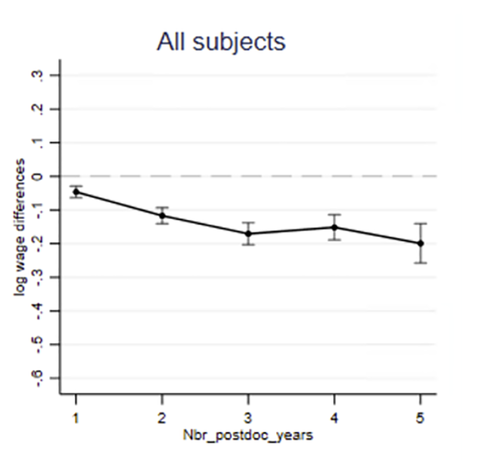
In most cases, doctoral graduates leave universities some years after graduation. How much do doctoral graduates earn when they leave university? Do postdoc years monetary pay off outside academia? In a recent paper, Johannes König shows that postdoctoral time does not result in wage premiums but is associated with wage losses outside academia. Moreover, the later doctoral graduates leave academia, the less they earn in the private sector (in the first five years after graduation). The wage gap is sizable and rapidly grows with postdoc time (see Fig 1). The first postdoc year is associated with a wage loss of 5% compared to no postdoc experience. Leaving five years after graduation is associated with a wage loss of 18%.

Picture
Fig 1. Earnings differences in relation to retention in science. Adopted from Koenig (2022).
Johannes finds this pattern in the labor market, analyzing more than 33 000 observations within an extensive 15 years timeframe (graduates between 1994 and 2009). This pattern holds on the five largest subject fields: humanities and arts, social sciences, science and mathematics, medicine, and engineering.  Moreover, these findings "can be considered representative of doctorate recipients who were employed as postdocs at universities for up to 5 years after graduation and later changed the employment sector".
 
Naturally, the question arises if selection plays a role: Perhaps, the most productive, ambitious postdocs stay in academia, while others leave with no wage premium or loss. Apart from including a set of control variables that can account for the difference between doctoral graduates, Johannes uses a matching approach that shall partially reduce this concern. He matches statistically comparable doctoral graduates on observable characteristics, e.g., age,  citizenship, previous work experience, and compares the wages among them. Yet, the pattern remains unchanged after this procedure suggesting the robustness of the observed wage gap.
 
These results beg the question if one can consider the postdoctoral period as a further qualification used to justify a postdoc's relatively insecure working conditions. Why is the payoff so low if the postdoctoral period is deemed the advanced qualification phase?
 
Read more:
König, J., 2022. Postdoctoral employment and future non-academic career prospects. Plos one, 17(12), p.e0278091.
​
1 Comment

Can group identity explain the gender gap in the recruitment process?

1/6/2023

1 Comment

 
Picture
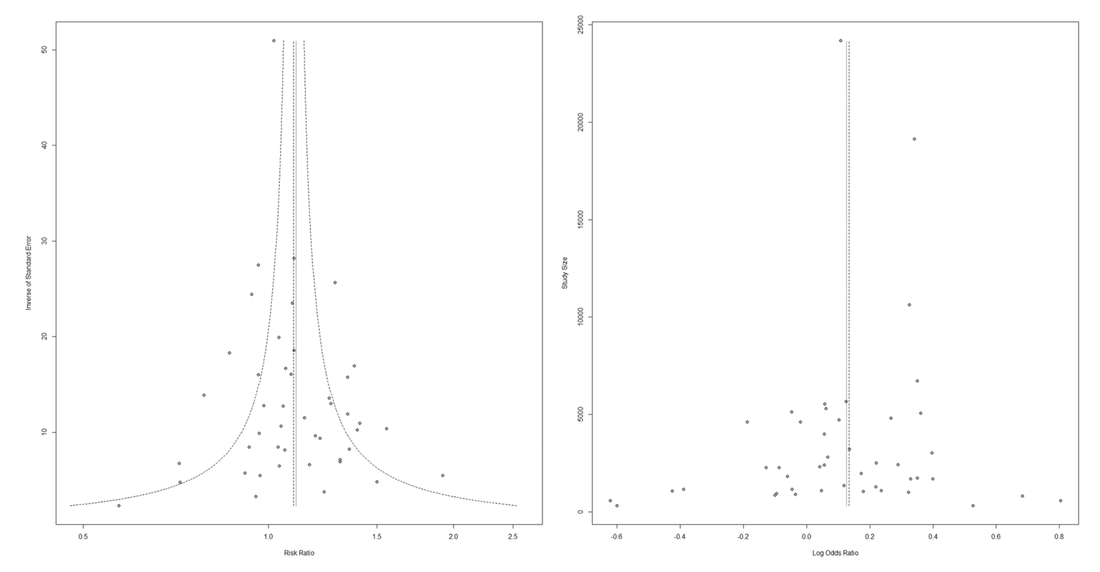
​Being interested in the gender gap in the labor market,  we (Maria Mavlikeeva and I) were intrigued by the somewhat counterintuitive observation in the literature and the result of our meta-analysis of correspondence studies: On average, women are more likely to be invited for job interviews than men (see Fig. 1). This result is at odds with the overall gender gap in the labor market, which favors men.
Picture
Fig. 1. Funnel plot of risk ratio (left) and odds ratio (right) of callback for female compared to male. Each dot represents an estimate of this effect from each correspondence study.
​To explain this counterintuitive result, we developed a hypothesis based on group identity theory: As recruiters may favor applicants of their gender, the predominance of female recruiters is responsible for a higher rate of women being invited for job interviews than men. We used data from our large-scale correspondence study to test this hypothesis. In this correspondence study, we randomly varied the gender of the applicant (male or female applicant name) on the resumes sent in response to real job openings; then, we measured the rate of callbacks for interviews. 
​
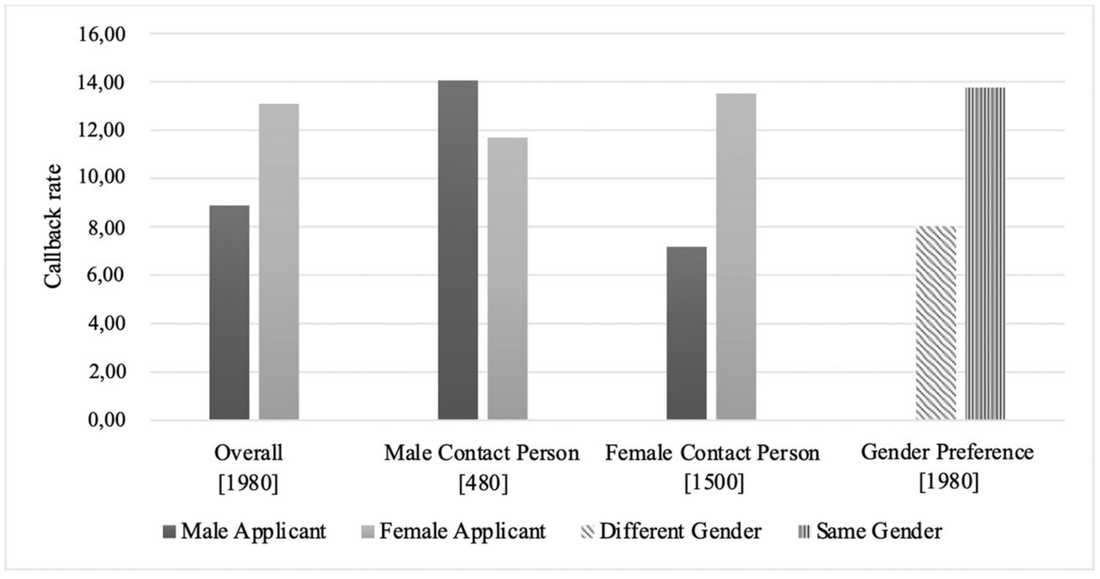
​​As expected, we found that female applicants were more likely to receive callbacks for interviews. We also observed that the majority of the contact persons responsible for the recruitment process in our sample were female. But perhaps most importantly, we found that if the recruiter and applicant were of the same gender, the probability of the applicant being invited for an interview increased (see Fig. 2).  These findings suggest gender-based in-group favoritism in the recruitment process.
Picture
Fig. 2 Gender preferences in callbacks (Callback rate in percent, number of resumes sent in square brackets).
The evidence of in-group favoritism in the recruitment process offers a promising avenue for addressing gender-based hiring discrimination. Ensuring that recruiters' positions at various levels are equally appealing to all genders can help to decrease gender-based bias during the selection stage of the recruitment process for other applicants. Moreover, incorporating discussions of in-group bias, regardless of gender, in diversity training could be beneficial to equalize employment opportunities.

Read more...

Asanov, I., & Mavlikeeva, M. (2023). Can group identity explain the gender gap in the recruitment process? Industrial Relations Journal, 54, 95-113. https://doi.org/10.1111/irj.12392


1 Comment

Bandit cascade: A test of observational learning in the bandit problem​

7/16/2021

1 Comment

 
Picture

Highlights
  • I experimentally study social learning in the simple two-armed bandit problem.
  • Two- armed bandit setting allows me to confront different theories of social learning.
  • Results are in line with counting heuristics, but not Bayesian-based reasoning.
  • Results urge incorporation of count heuristics in the theory of social learning.
  • Results helps to explain the technology, practice adoption failure, poor investments.
​

Abstract: I conduct an experimental investigation of observational (social) learning in a simple two- armed bandit framework where the models are based on Bayesian reasoning and non- Bayesian count heuristics providing different predictions. The agents can choose between two alternatives with different probabilities of providing a reward. They must make their choice in order to see the outcome and act in a sequence. They can base their decision on the choices of the predecessors and the outcomes of their own choice. The results of the experiment follow neither Bayesian Nash Equilibrium nor Naïve herding model (BRTNI): Subjects follow and cascade on choices that contain no information about the state of the world, and, therefore, sustain losses when learning from others. I also test the Quantal response equilibrium and the robustness of this theory.

Igor Asanov, Bandit cascade: A test of observational learning in the bandit problem, Journal of Economic Behavior & Organization, Volume 189, 2021, Pages 150-171, ISSN 0167-2681, https://doi.org/10.1016/j.jebo.2021.06.006.
​

[Read more...]
1 Comment

Weekly Links 06th of October

9/6/2019

2 Comments

 
Picture
  • "Girls’ comparative advantage in reading can largely explain the gender gap in math-related fields" by Breda and Napp (2019), PNAS. Very interesting paper that the difference in reading abilities  between boys and girls  in early age can explain the gender gap in math-career and  intentions. I am not 100% sure what is policy implication given the complexity of the issue e.g. family planning, but authors argue "to better inform students regarding the returns to different fields of study, something that is likely to trigger large effects on educational choices". Indeed,  informational treatment can improve job prospects in general population  and Breda et al. (2018) show that in girls. However, do we improve them or bias?
  • "A project-management tool from the tech industry could benefit your lab" by David Adam (2019), Nature.  A friend of mine pointed out to me a "Scrum" as  useful tool to for project management used in the industry. It is interesting to see that advocates of this approach in science. 
2 Comments

Weekly Links 24th of August

8/24/2019

0 Comments

 
Picture
  • "A national experiment reveals where a growth mindset improves achievement"  by Yeagar and large group of coauthors (2019), Nature.  Extremely interesting paper on the effect of a short online growth mindset intervention on grades and enrolment to advanced mathematics among US school students.  From technical point of view, I found very interesting  the whole process of data analysis: "Confidence in the conclusions of this study comes from independent data collection and processing, pre-registration of analyses, and corroboration of results by a blinded Bayesian analysis."  (Yeagar et al., 2019) 

  • "Civic honesty around the globe"  by Cohn et al. (2019), Science.  Puzzling result in large experiment across 40 countries. People are more likely to return the lost wallets with cash than without cash in it. Experts were not capable to predict these results. Further research is needed to better understand the reason for these results and generalisability of implication.
​
  • "A standardized citation metrics author database annotated for scientific field" by  Ioannidis et al. (2019), PLoS biology.  The study develops a large citation database and shows that a large number of the authors' citations comes from self-citations or citations by co-authors. In extreme cases, it can reach 94% raising the question to what extent citation indexes are accurate (see nice summary and discussion in Nature). The paper reminded me of the paper by Dominik Heinisch et al. (2016). They show that patterns of knowledge diffusion measured by citations of patents to non-patent literature changes drastically once one excludes individual and organizational self-citation. ​ Dominik is my co-author in another paper and we worked  in the same research group.  How fair is it for me to cite his paper? 
0 Comments
<<Previous

    About this Blog

    I would like to share some random thoughts on the research topics that I find  interesting and my research activity.

    Archives

    November 2025
    October 2025
    September 2025
    November 2024
    January 2024
    January 2023
    July 2021
    September 2019
    August 2019
    June 2019
    April 2019

    Categories

    All

    RSS Feed

Powered by Create your own unique website with customizable templates.